

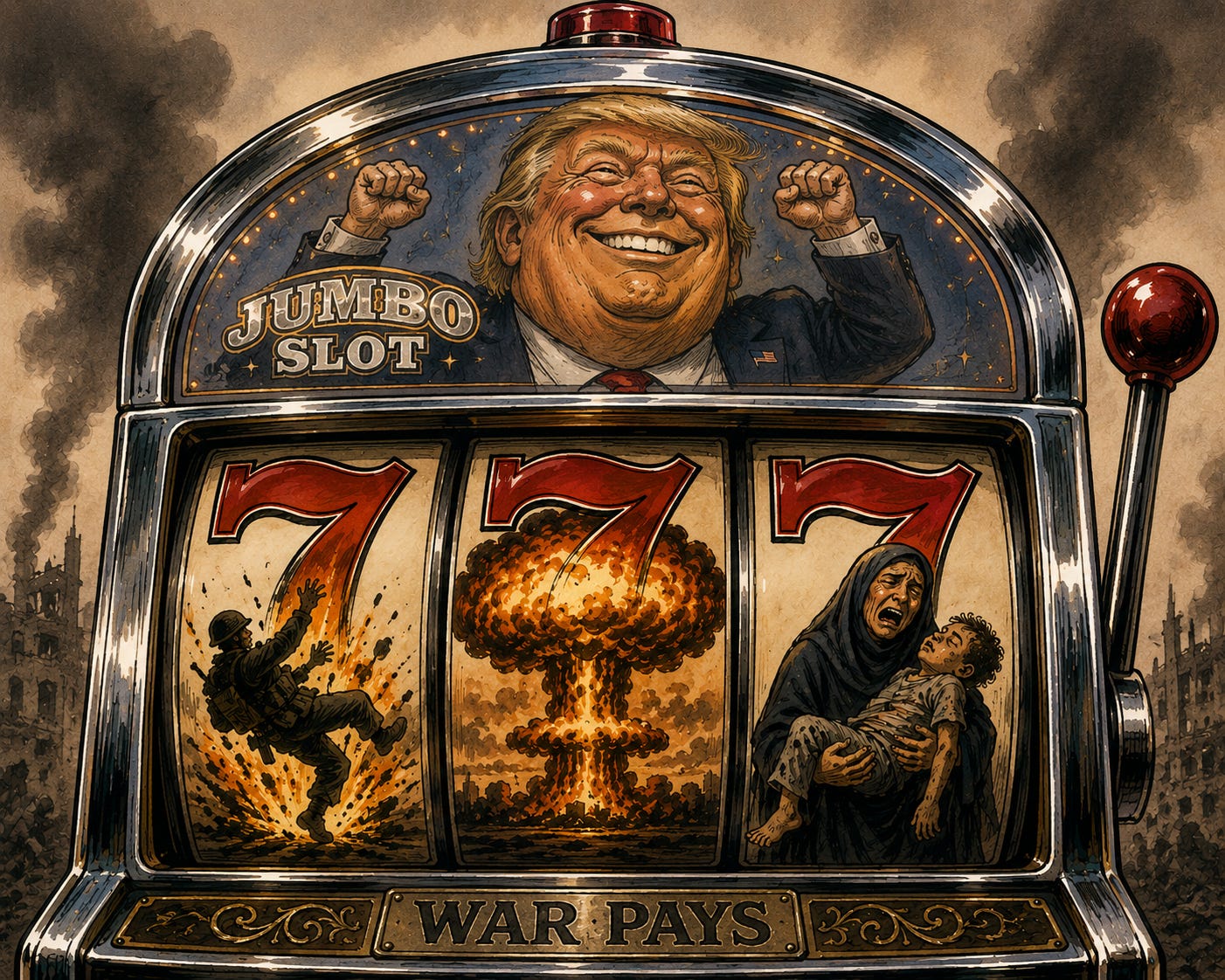
It isn’t hard to spot the pattern:
Peace is declared. Oil prices go down. War returns. Oil prices skyrocket. Peace is declared. Oil brices go down. Rinse, repeat.
How would you make money from that, if you were a supremely dishonest, amoral, profitizing president? Simple: Buy low, sell high. Buy peace — and then crank up the war. Oil spikes. You sell. You declare that peace is at hand! Oil drops. You buy. Crank up the war again!
This is exactly what is afoot.
And much, much more.
The Evidence
This is not speculation about vibes. It is documented movement of large sums of money in the minutes before the public learned what was about to happen.
In early March, Reuters and the Financial Times both reported that traders placed roughly $500 million in crude oil futures bets about fifteen minutes before the White House announced a pause in strikes on Iran’s energy infrastructure. Rep. Ritchie Torres called it potentially the largest instance of insider trading in American history and formally asked the SEC and CFTC to investigate.
In late March, Sen. Chris Murphy identified a trade in which $1.5 billion in S&P 500 futures were bought while $192 million in oil futures were sold, in the minutes before Trump announced a five-day pause in strikes.
In April, a $760 million bet on falling oil prices was placed roughly twenty minutes before Iran's foreign minister announced the Strait of Hormuz was open to commercial traffic. Reuters reported the trade directly: investors sold 7,990 lots of Brent crude futures in a single minute. Brent fell more than 10 percent within the hour; WTI fell as much as 12 percent. Rep. Ritchie Torres asked the CFTC to expand its investigation to cover this trade as well.
A later Reuters analysis found a pattern across four separate days — March 23, April 7, April 17, and April 21 — each time involving large, well-timed sales of oil and fuel futures minutes before a Trump announcement moved the market. Reuters put the combined total at roughly $7 billion. A veteran oil trader consulted by Reuters, said the trades looked "well informed."
Blockchain analytics firm Bubblemaps identified nine connected Polymarket accounts that earned $2.4 million with a 98 percent win rate across more than 80 bets on U.S. military actions in Iran. Four of the accounts made roughly $400,000 each on the February 28 strike alone.
Separately, the Financial Times reported that a broker for Defense Secretary Pete Hegseth contacted BlackRock in February about a multimillion-dollar investment in a defense-sector fund, weeks before the February 28 strikes. Sen. Elizabeth Warren, ranking member of the Senate Banking Committee, sent a letter to the SEC on April 20 requesting a formal investigation into the matter.
What the cases above describe is money moving on the precise timing of war and peace, before the public had any way of knowing which was coming.
Perverse Incentive
A government facing a costly, unpopular war typically has pressure pushing it toward ending the war. But what is actually being rewarded here? Every escalation moves oil and defense-adjacent assets. Every de-escalation moves them back. That means profit is not tied to which side wins. It is tied to the swing itself. Escalation rewards one set of positions. De-escalation rewards the opposite set. Someone who knows in advance which is coming can profit either way.
That is not a flaw in the system. It is a structure that pays out regardless of direction, as long as there is still a direction to bet on. The one outcome that is not rewarded is a stable, lasting peace — because a stable peace ends the swings, and the swings are where the money is.
The Cost in Blood, Treasure and American Prestige
While this pattern repeats, the human toll continues to rise for people with no stake in any of these trades. Estimates put total deaths across all sides between roughly 9,000 and 18,000 as of early August, depending on the source. Seventeen to twenty American service members have been killed and hundreds wounded.
The financial bill is not abstract, either. The Pentagon’s own comptroller told Congress the first six days of the war alone cost $11.3 billion — roughly $1.88 billion a day. By the time an early ceasefire held in mid-June, one running tally built from Pentagon briefings put the total at $113.3 billion over 108 days. That figure covers direct military costs only: munitions, deployments, fuel for the fleet. The nonpartisan group Taxpayers for Common Sense estimates the public’s fuel costs at the pump — separate from anything the Pentagon spent — at more than $40 billion and climbing.
Some economists, factoring in long-term veteran care, debt servicing, and reconstruction obligations, warn the Iran war’s lifetime cost could eventually exceed $1 trillion.
And the world has been watching, closely and unfavorably. A Pew Research Center survey of 36 nations found a median of 74 percent of adults disapproved of how the war was being handled. Favorable views of the United States itself declined by double digits in many places. And for the first time in Ipsos’s tracking, more people globally believe China will have a greater positive impact on the world over the next decade than the United States — 50 percent to 39 percent.
Americans themselves are deeply unhappy. Chicago Council polling from mid-July found 68 percent of Americans now say the war’s costs have outweighed its benefits. Majorities said it has been bad for their cost of living (86 percent), for America’s international relations (72 percent), for the country’s reputation abroad (72 percent), and for national security itself (65 percent).
Yet the war goes on, and on, And on.
And the profits of gambling the live of American soldiers and Iranian civilians continues to flow into Republican coffers.