

Alisa Valdes-Rodriguez posted this yesterday:
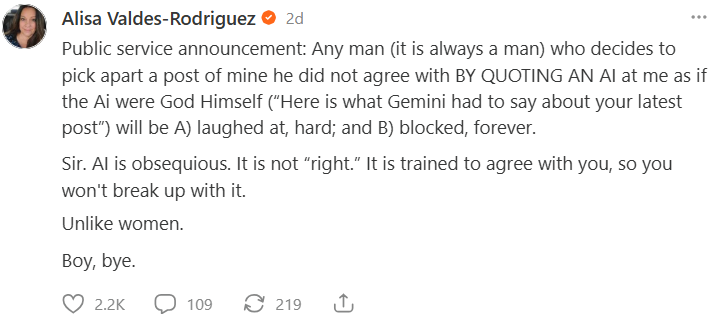
Now I was intrigued. Did some guy just randomly pick a fight with her to be an asshole? Or was he just telling her she’d made a factual error, and she took umbrage?
Her reaction seemed odd to me. If someone fact checks me, and I’ve gotten something wrong, I simply thank them, and make a correction. If I’m right, I might explain why and move on. The hostility seemed both wrong and unprofessional.
I went to Alisa’s page and found an article on water quality that I had intended to read, after a fact check.
As I told her in response to the post above, ‘I never read anything of any length in the wilds of the internet without an AI fact check. I recommend the same for others — including you.’
My response continues:
Your piece is a fine example of why. Your credentials are impeccable. You have all the journalistic training in the world, and wonderful accolades. You’re as competent as one could hope for in a human.
You still got things wrong in your piece on water quality.
AI is not a god. AI gets things wrong all the time.
But have you talked to a human lately? We — including you — are quite fallible. And we’re not even pretend-objective about it. We believe what we believe. And if someone disproves it, we double down on the belief rather than accepting that we could have been wrong … about anything.
Ah, but we are.
And here on Substack, especially, folks are working without a net. No publisher looking over our shoulder; no editor staring at you balefully over the rims of her glasses; no fact checkers to double check us.
We’re the science people, remember? Those things are the science of journalism. Those redundancies give journalism credibility, and some assurance of accuracy. Otherwise, no matter who we are, we’re just flying by the seat of our pants and hoping for the best.
Ah, but … we have AI!
AI can be trained, by you, to be critical … of you. AI can also be trained to draw from only select sources. AI can be a godsend to a writer who can’t afford a fact checker or an editor.
And yes, it IS obsequious. To anyone who goes that route, I emphasize: Train, train, train, and keep training. Tell it every time, ‘I want to know if this is accurate. And do NOT blow sunshine up my ass. If fact, I want to be wrong. If you don’t find things wrong with what I wrote, I’ll use another AI who can do the job.’ Be stern and brutal. It works.
We’re just humans. We no longer have to claw at the rocks and sand with our hands — we have shovels. Use the tools available to you. Like Google was a tool, AI is a tool. Use it carefully, just as you would Google.
Now, laugh at me and block me if ye will. Imma still keep fact checking stuff.
Like your recent article on water quality (Note: Alisa’s article suggested that tap water is causing obesity. I did not challenge her on this claim, though it fails a fact check. I thought I would offer a fact check that actually worked in her favor, to dampen my rebuttal. Continued:).
No, obesity doesn’t cost $173 billion annually.
Those are old numbers.
According to Gemini (ahem), obesity ‘costs $260 Billion to $300+ Billion (reflecting full direct medical expenditures).
Total Societal Impact (Direct + Indirect): If lost workplace productivity, absenteeism, short-term disability, and military unfitness are added, the total annual economic burden exceeds $1 trillion.’
Now: Why would you not want to correct that — especially if it strengthens your own piece?
And by the way — fact check the things I wrote. I’m just human. I also consulted AI. All of it and everything and me and you and Google and even fact checkers and editors can get stuff wrong.
But if we rely on each other and all the tech we have, we might just get it right.
———————
That was all I wrote.
As promised, she blocked me.
Which is a pity. I really do enjoy her writing.
But more importantly, it is revealing of her character. A journalist who cannot egoically survive something as germain to the journalist process as a fact check certainly isn’t going to publishing any retractions anytime soon. And journalism without corrections and retractions is not credible journalism. It is a vanity project.
Take your writers to task, folks. And if they don’t have a publisher, they most likely don’t have an editor or fact checker. That leaves you — and the tools at your disposal. Use them well — and use them before you invest a lot of time in an article. Because misinformation, once swallowed, is as difficult to dislodge as microplastics in tap water.